Every franchise eventually reaches a moment where the question isn’t whether a star is great, it’s whether he’s still great for the franchise. The NBA is a league built on timelines, contracts, injuries, and the unforgiving truth that not every core is meant to last forever. To understand whether a team should consider moving a star, I had to zoom out and look at the last four seasons (in one case, I used all 5 years of his career). The clearest sample of who a player is, how available he’s been, how far he’s taken his team, and whether his organization’s direction still matches his trajectory.
This isn’t about disrespecting players. It’s about alignment. It’s about honesty. It’s about whether the franchise and the star are still walking toward the same future.
These are the ten players whose teams should at least consider moving. Not because they’re bad, but because the timelines, contracts, and results demand the conversation.
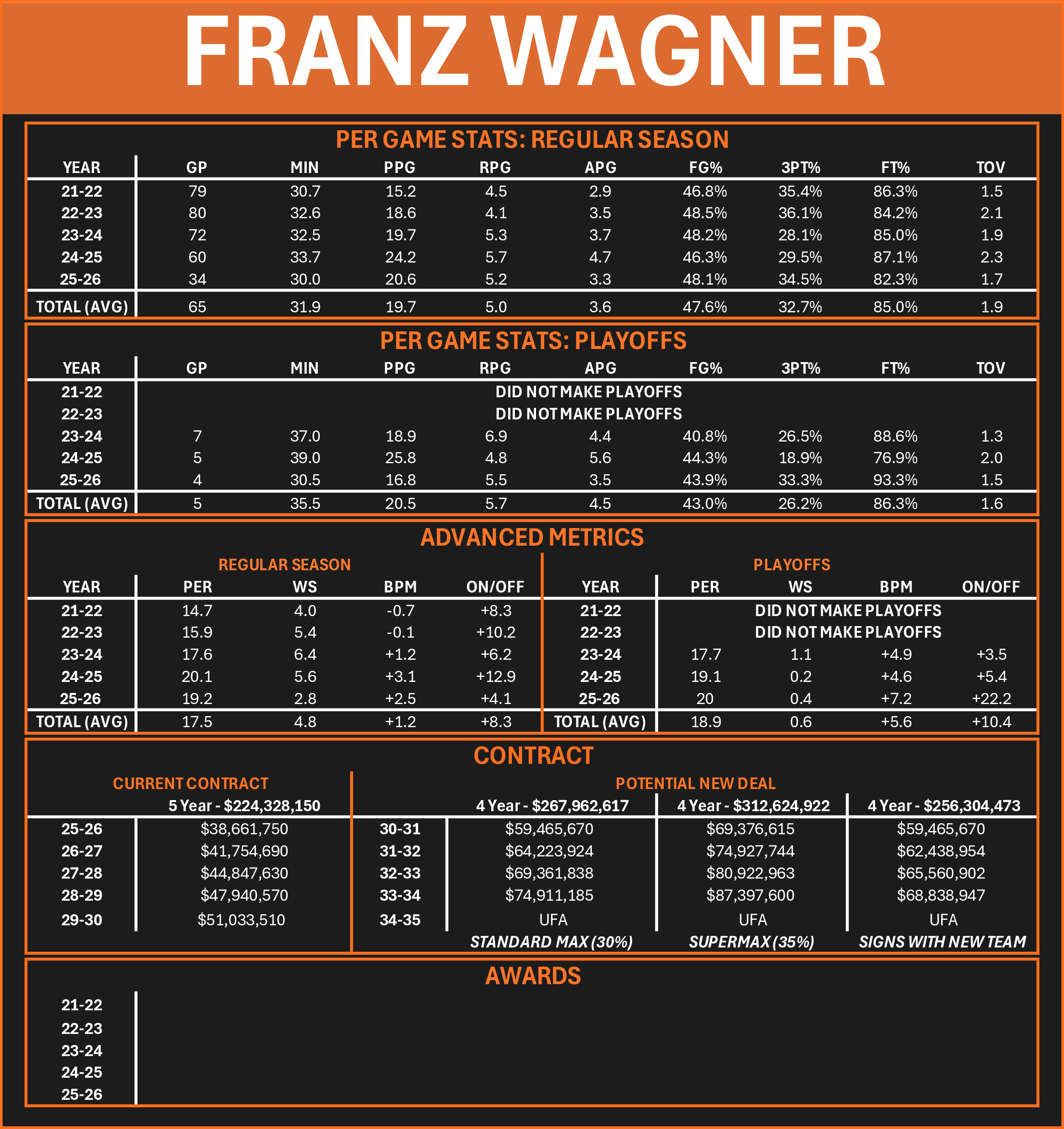
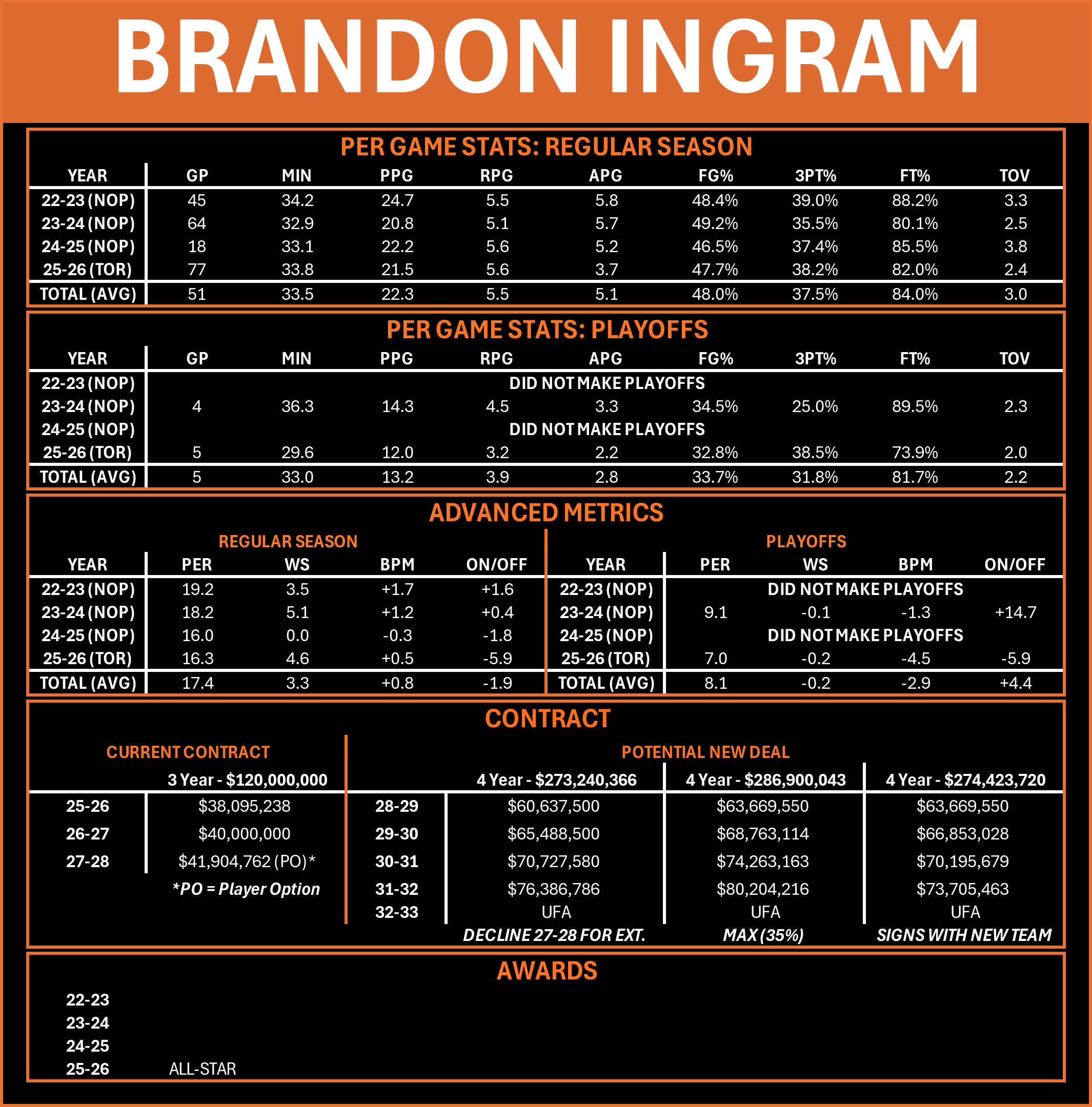
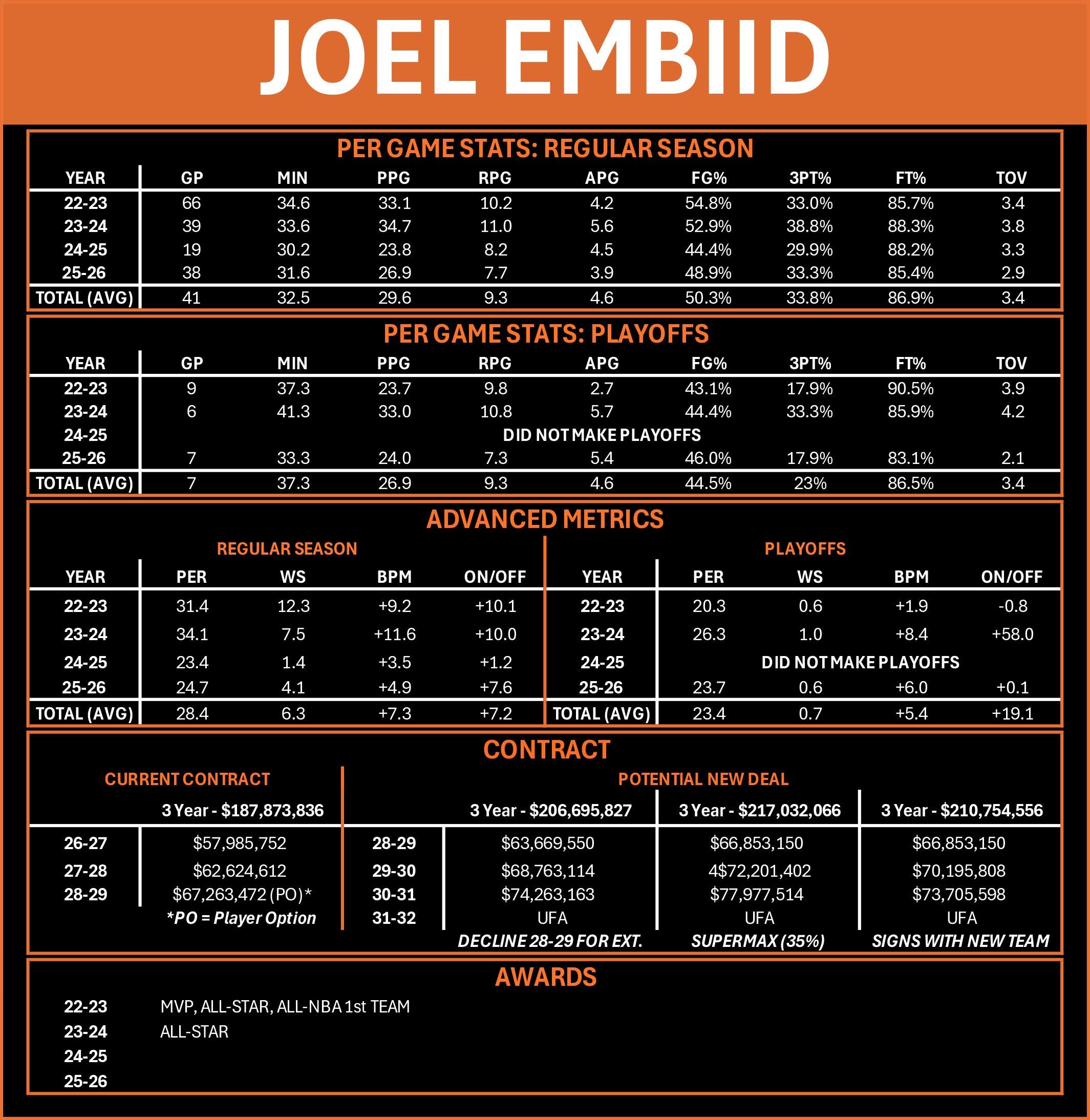
(In each section, you will see visuals of players’ stats and their current and potential contracts. To remain consistent, I only did 4-Year max contracts, although, given the circumstances, players can sign for 5-Year supermax contracts with their current team. The salaries listed are the max the player would be able to obtain, although their current team or new team may sign them for less.)
10. FRANZ WAGNER — ORLANDO MAGIC
Franz Wagner is beloved in Orlando. He’s young, skilled, versatile, and a perfect complement to Paolo Banchero. But the injuries are adding up (ankle issues, oblique tears, calf strains), and the availability is becoming a real concern. In this year’s playoffs, Orlando was up 3–1 on the No. 1 seed Detroit Pistons, with momentum in their hands, and Franz missed Games 5, 6, and 7. A calf strain is no joke, but the timing was brutal.
Then came the firing of Jamahl Mosley. The coach who built the identity, developed the young core, and brought the Magic back to relevance. Now, Orlando is at a crossroads. Is this a reset? A retool? A pause until Paolo hits his peak?
Franz’s contract has forced Orlando to fill the roster with low‑impact, low‑ceiling players: Jonathan Isaac, Jalen Suggs, Goga Bitadze, and Tristan da Silva. A crowded roster full of players who don’t solve the scoring‑point‑guard problem and don’t move the needle. Luckily for the roster, Jett Howard and Moritz Wagner will help address this issue by entering unrestricted free agency this summer.
Orlando shouldn’t rush into anything. They shouldn’t force a trade. But they should explore. Because Paolo’s timeline is accelerating, and the Magic need to know what options exist before they lock themselves into a ceiling that’s too low.
And it’s worth remembering that Franz is already under contract through the 2029–30 season, which gives Orlando real time and flexibility to evaluate who he becomes. The injuries are a concern, the roster construction is clunky, and the scoring‑guard problem still hasn’t been solved, but the Magic aren’t staring at an immediate deadline. With the cap projected to rise 10% every year, Orlando will gain additional room to reshape the roster around Paolo Banchero, add real impact players, and correct the low‑ceiling depth they’ve been forced into. Franz’s deal doesn’t trap them. It simply raises the stakes on getting the next moves right.
9. BRANDON INGRAM — TORONTO RAPTORS
Brandon Ingram’s move to Toronto felt like a fresh start. LA was too bright. New Orleans was too chaotic. Toronto offered something rare: a place where he could hoop without the spotlight. And after the trade, he did exactly that. His scoring, efficiency, and playmaking all ticked up. He fits great next to Scottie Barnes and RJ Barrett. Toronto suddenly was ahead of schedule. A young, long, positionless group that could switch everything and score from all 3 levels.
And that’s the key: the Raptors were ahead of schedule. This playoff run wasn’t supposed to happen just yet, but maybe in a year or so, when their draft prospects (Gradey Dick, Ja’Kobe Walter, and Collin Murray-Boyles) have a little more experience and development. But because it did, Ingram’s availability became a real issue sooner than expected.
He played the first five games of the series. He helped push Toronto deep into the first-round series against the Cleveland Cavaliers. Then, a heel spur shut him down for Games 6 and 7. Painful, yes. Limiting, absolutely. But the kind of injury that lives in the gray area between “hurt” and “injured.”
Ingram didn’t dress. Toronto lost by twelve in Game 7. Season over.
If you’re Bobby Webster, that moment sits in your stomach. You finally get a real star next to Scottie, and when it matters most, he’s unavailable. Not for a month. Not for a series. For two games. Two games that could have changed the entire trajectory of the Raptors’ franchise.
Now the Raptors face a brutal decision: extend him for $200+ million or flip him for multiple pieces and picks. He’s only 28, with four high‑level years ahead. He fits Scottie’s timeline. He fits the roster. He fits the city.
But availability matters more than talent in the playoffs. And Toronto, for the first time since their 2019 championship run, has something worth protecting: momentum.
Toronto has to decide whether Ingram is a pillar or a trade chip.
8. JOEL EMBIID — PHILADELPHIA 76ERS
It’s time to talk about Joel Embiid. Not the MVP version, not the “when healthy” version, but the real version. The one who is 32 with chronic knee issues. The one who has carried the franchise through regular seasons only to watch the playoffs unravel around him. The one who has lived through more heartbreak than any superstar of his era.
The Process has been long, painful, chaotic, and ultimately incomplete. Markelle Fultz. Ben Simmons. Tobias Harris. Jimmy Butler. Paul George. Nothing stuck. Nothing aligned. Nothing worked long enough to matter. Daryl Morey was fired after the conclusion of this season. The front office is resetting. And Philadelphia is a brutal city. Philadelphia demands winning, not excuses.
Embiid is still an MVP‑level talent, but the age and injuries are catching up. He gets teams to the playoffs, but when the lights get brightest, his supporting cast disappears. And the heartbreak keeps piling up. How different would his career look if Ben Simmons didn’t pass up that dunk in Game 7 of 2021?
And here’s the uncomfortable truth: Embiid’s trade market is almost nonexistent. Rival teams are terrified of taking on nearly $200 million for a player who struggles to stay on the floor in April and May and has chronic knee issues. I would assume the Sixers would have to attach multiple picks to move him.
And then there’s the unsettling option: medical retirement. If Embiid is physically unable to play for a full year, the Sixers can petition the league to wipe his contract off their books entirely, while Embiid would still get every dollar through insurance. It’s the only scenario where Philadelphia gets a clean slate.
Paul George is 36. The window is closing. A full reset is coming, whether Philly admits it or not. Trading Embiid while he still has a few elite years left is the smart move. That is, if anyone is willing to take the risk. Sixers get the flexibility, and Embiid gets to chase a ring somewhere else.
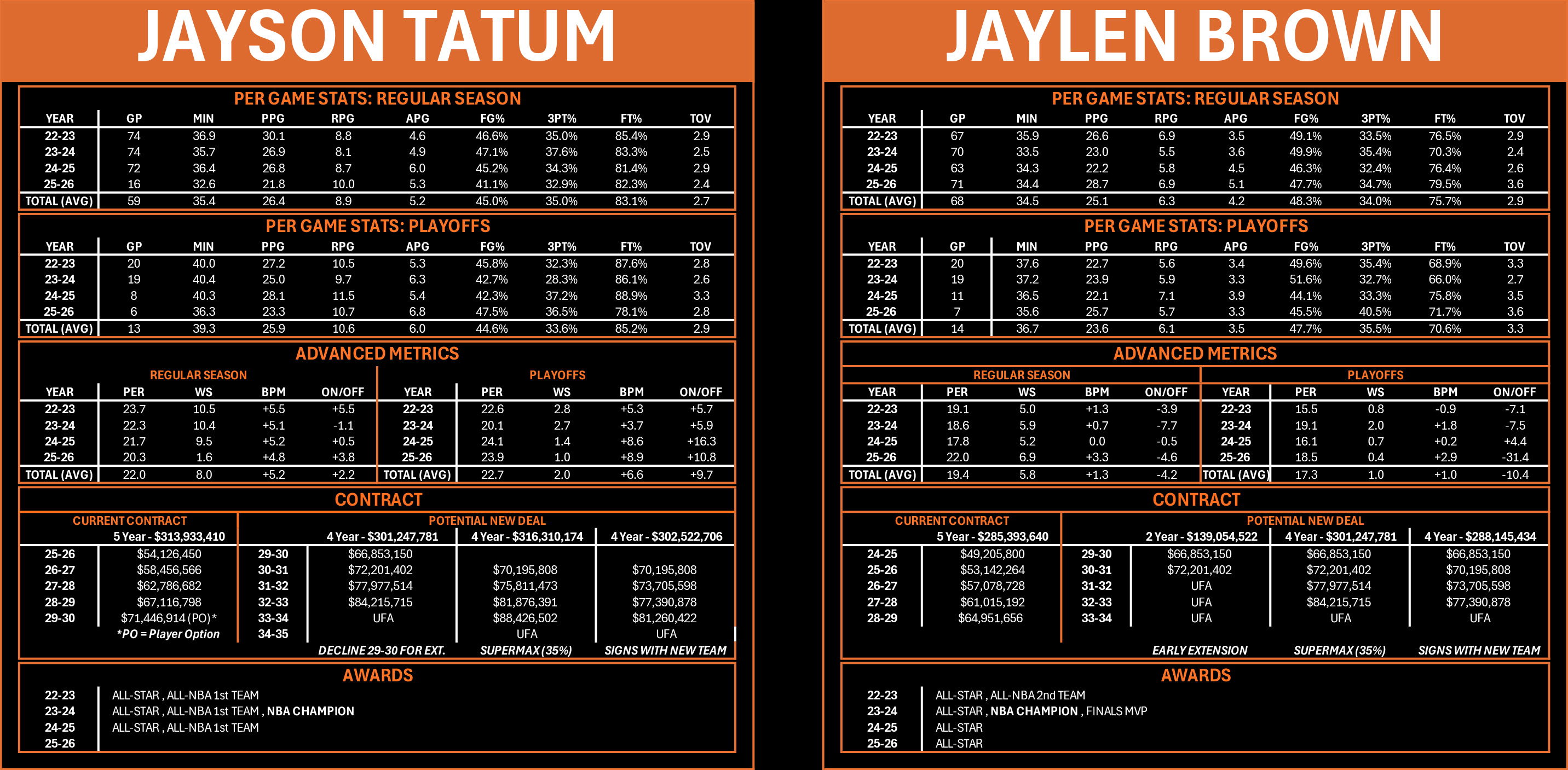
7. JAYSON TATUM — BOSTON CELTICS
Boston has reached the point where the question that once felt hypothetical now feels unavoidable. For years, the debate lived on talk shows and message boards: If the Celtics ever had to choose, would it be Tatum or Brown?
It was always dismissed as noise. The kind of conversation that only exists when a team is too good to break up but too flawed to fully trust. Tatum’s injury in 24-25 has changed everything. How the 2025-2026 season ended has changed everything.
Tatum’s Achilles tear altered the timeline. He fought back for sixteen regular‑season games, averaging 21 and 10, exceptional numbers for someone returning from one of the hardest injuries in basketball. But Achilles injuries don’t care about future optimism. They take explosiveness. They take longevity. They take certainty.
Then came Game 7 in Boston. Tatum sat out with knee stiffness, not a major injury, not a long-term concern, just one of the unfortunate timing issues that happens. Like the Brandon Ingram and Franz Wagner scenarios discussed previously. But because of this, the injury exposed how fragile the roster was built with low-impact players. Joe Mazzulla pivoted to a head-scratching lineup for Game 7: Ron Harper Jr., Derrick White, Jaylen Brown, Baylor Scheierman, and Luka Garza.
Meanwhile, Jaylen Brown quietly stepped up to the plate in Tatum’s absence. He’s been in Boston a year longer. He’s been more consistent in the playoffs. He’s been more durable.
But here’s the real debate: Brown’s on/off numbers aren’t great. Tatum’s injury is terrifying. One is a statistical risk. The other is a medical risk. And Boston can’t afford to get this wrong.
A difference that matters when both players are making north of $55 million per year.
That’s where the evaluation gets complicated. Boston is choosing between two different kinds of risk: the statistical risk with Brown and the medical risk with Tatum. One is about what the numbers say. The other is about what the body might do. And the Celtics can’t afford to get either one wrong.
And here’s where the conversation becomes real: The most logical Tatum trade is Tatum for Giannis. Tatum makes $62.8 million. Giannis makes $58.4 million. The salaries are close enough to work with minimal filler. The star power matches. The timelines match. The needs match.
Boston gets the interior force and defensive anchor, something they’ve lacked since their championship run. Milwaukee gets a younger superstar with a decade left in his prime. Both teams get a reset without rebuilding.
But Boston shouldn’t push the button yet. They should explore. They should gather information. They should use Brown as the insurance policy while they see whether Tatum returns to form.
The Celtics need a point guard. They need a center. They need flexibility. And Derrick White’s shooting, once the X‑factor of the 2024 Finals run, went MIA in 2026. The roster has become top‑heavy, expensive, and inflexible. The bench was an eyesore and ineffective.
This offseason isn’t the moment to act. It’s the moment to prepare.
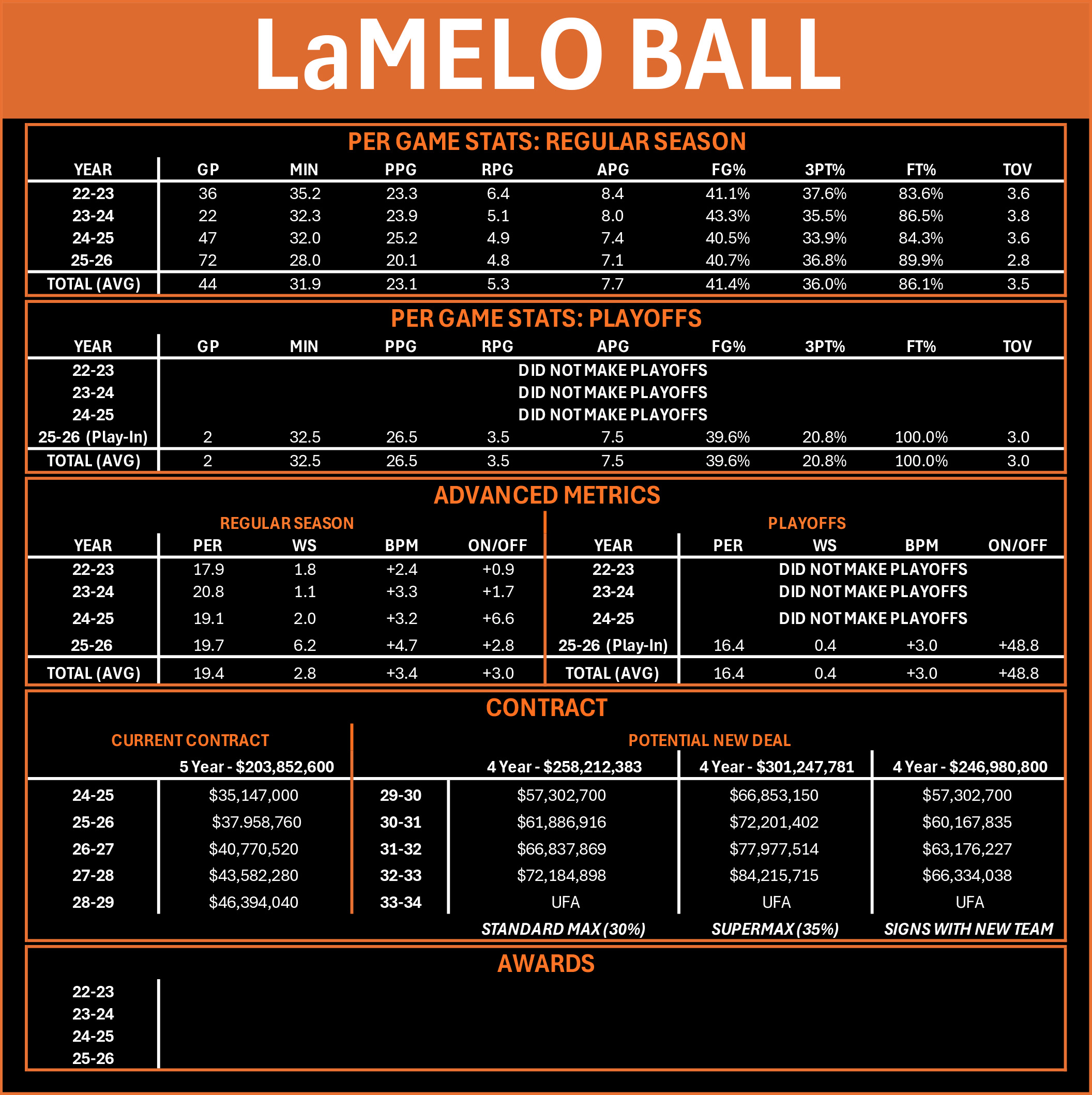
6. LAMELO BALL — CHARLOTTE HORNETS
Charlotte finally has direction. Charles Lee is the right coach. Jeff Peterson nailed the 2025 draft (Kon Knueppel, Liam McNeeley, Sion James, and Ryan Kalkbrenner). They have a young core (Brandon Miller, Miles Bridges, Coby White, Tidjane Salaun, and Moussa Diabate). For the first time in years, the Hornets look like a team with a plan.
But LaMelo Ball is the question mark that won’t go away.
LaMelo plays like he’s wearing AirPods at the rec. Flashy. Loose. Unbothered. Immature. When you think of LaMelo, you don’t think “franchise cornerstone.” You think highlights. You think heat checks. You think inconsistency.
He has averaged 51 games per season, just 62% of the regular season schedule. He has never led Charlotte to the Playoffs. He has one All‑Star appearance and one Rookie of the Year trophy. And now a massive extension is looming. Is he worth it? Is he the player you tie your franchise to for the next five years?
Charlotte has been stuck in the lottery and the play‑in for years. Never breaking through. Never taking the next step. LaMelo is the change. A trade for the No. 2 pick makes sense. LaMelo to Utah for No. 2 and Keyonte George. No. 2 and Ace Bailey. Draft Darryn Peterson and reset the timeline. Or send him to Chicago for No. 4 and Josh Giddey. Giddey and Patrick Williams. Charlotte receives cleaner fits, real point guards, and a potential top 5 pick.
Charlotte needs maturity, identity, and leadership. LaMelo gives them none of that.
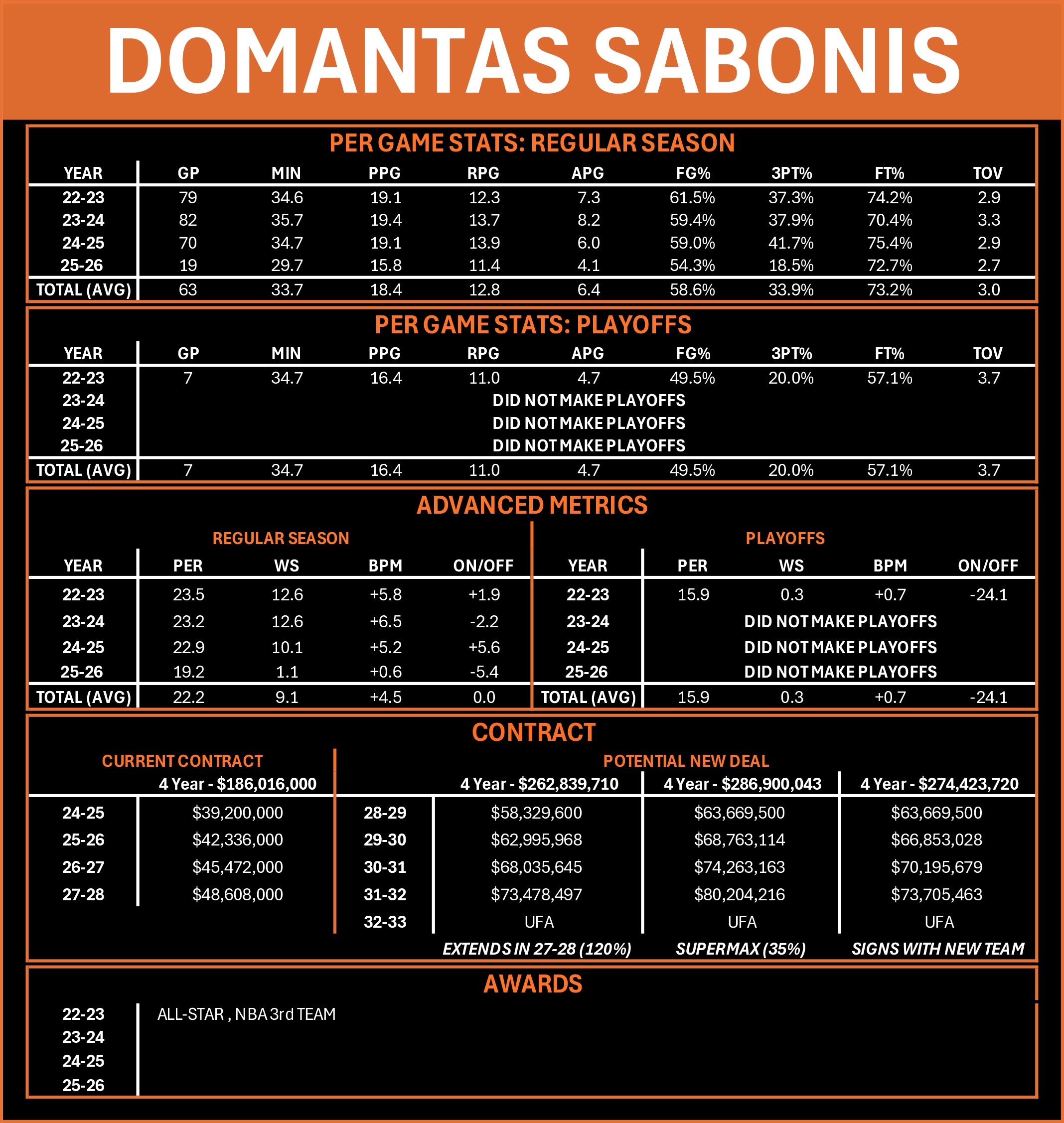
5. DOMANTAS SABONIS — SACRAMENTO KINGS
Domantas Sabonis is a winning player, a connector, a hub, a big who elevates everyone around him. But Sacramento is stuck in a strange situation. With De’Aaron Fox now in San Antonio, the Kings are left in a “What are we?” phase with no clear identity or direction.
Sabonis is 30, in his prime, and too good to waste on a team that doesn’t know where it’s going. His playoff efficiency has always been the question mark. Defenses tend to shrink the floor, dare him to score, and force him into uncomfortable spots. But in the regular season, he’s a machine. A stabilizer. A player who makes good teams great.
He deserves to be on a contender: Toronto, Detroit, Atlanta, Orlando, even Minnesota, where Rudy Gobert has proven he’s not enough. Sacramento, meanwhile, needs draft capital and flexibility. They hold the No. 7 pick, and they have movable contracts. They need to reset around the 2026 draft and build a roster that fits their new timeline, before rebuilding changes with the 2027 draft.
Sabonis isn’t the problem. He’s the solution, but not for the Kings.
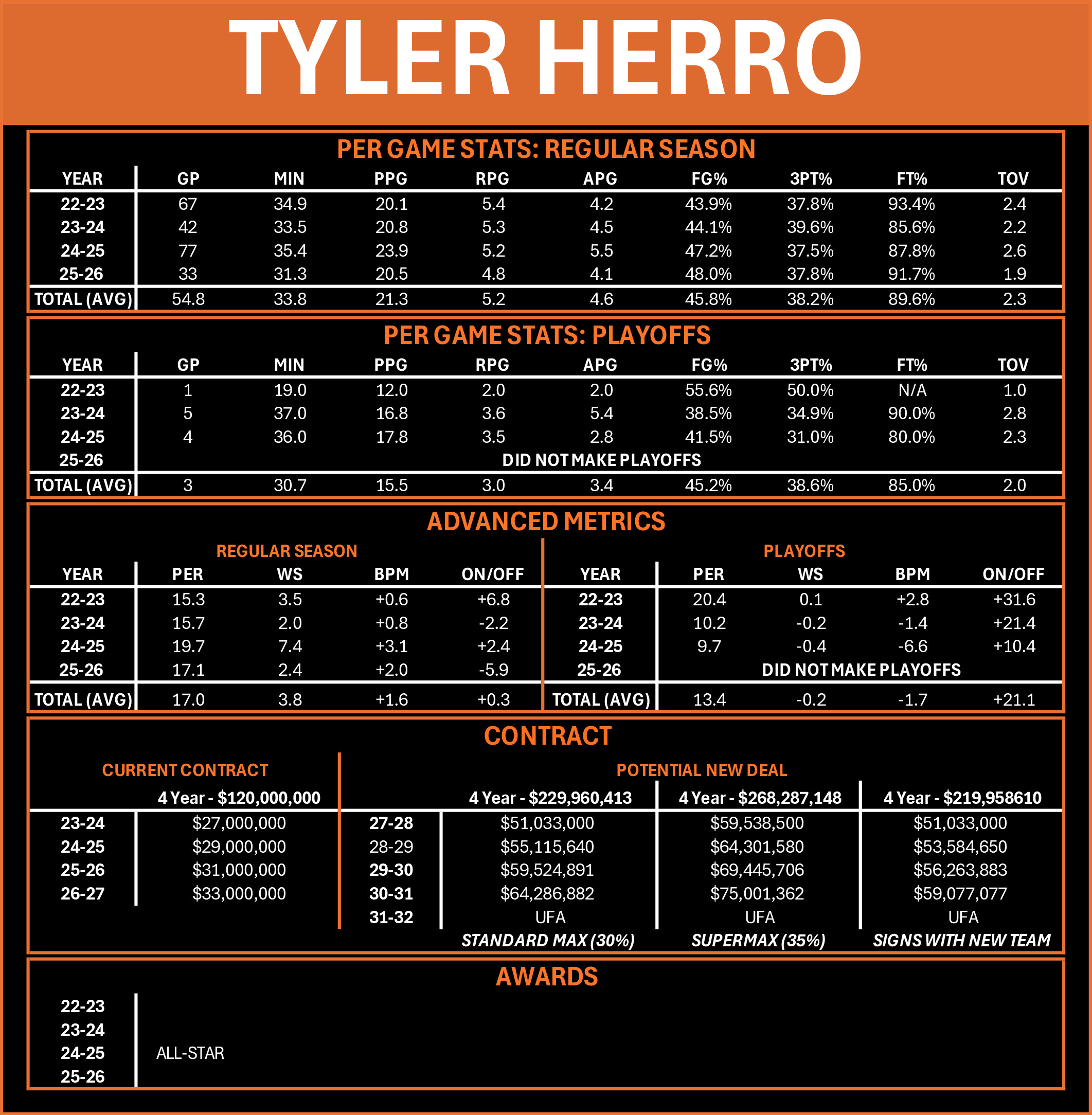
4. TYLER HERRO — MIAMI HEAT
Tyler Herro is exactly what he’s always been: a bucket. A smooth, confident scorer who can score 20 on any night and make it look effortless. But the version of Herro Miami once relied on, the one who helped them make deep playoff runs early in his career, hasn’t been the version they’ve gotten since. His availability has dipped, his efficiency has flattened, and the Heat’s timeline has shifted faster than expected.
Miami has quietly accepted that Bam Adebayo is the cornerstone. They’re not tanking, but they’re not contending either. They’re stuck in the middle. The worst place to be in the NBA. And Herro’s contract, once seen as a long‑term investment, now feels like a weight. It limits their flexibility. It blocks them from reshaping the roster around Bam. It forces them into a direction that no longer fits who they are.
If Miami wants to swing for a guard in this draft, they need a pick in the top six. Offloading Herro to the Clippers or Nets could get them No. 5 or No. 6. A chance at Darius Acuff, Mikel Brown Jr., or Kingston Flemings. Herro still helps a contender. But for Miami, he’s the piece that unlocks the next chapter.
And while the max projections outline Herro’s potential earning ceiling, the league surely doesn’t view him as a 30% max player. His defensive limitations, injury history, and the emergence of younger, cheaper guards mean his actual market value would fall well below these numbers. Most negotiations will likely mirror the tier of players who land in the $25–30 million range with incentives and partial guarantees, but not the full 30–35% max he could be eligible for.
3. ZION WILLIAMSON — NEW ORLEANS PELICANS
Time is now. Time has always been now. And somehow, it has never actually arrived.
Zion was a spectacle in college, but college basketball makes it easy to look spectacular. In the NBA, talent is concentrated into 30 teams. You can’t just jump over people forever. Zion is undersized for his position. He can’t shoot. He relies entirely on athleticism. And he is elite when healthy, but rarely healthy.
The Pelicans got stuck with the No. 1 pick in the wrong draft. One year too late for Luka. One year too early for Anthony Edwards. David Griffin extended him in 2022. A decision that still makes no sense. He bet on hope. He bet on potential. He bet on a version of Zion that never existed consistently.
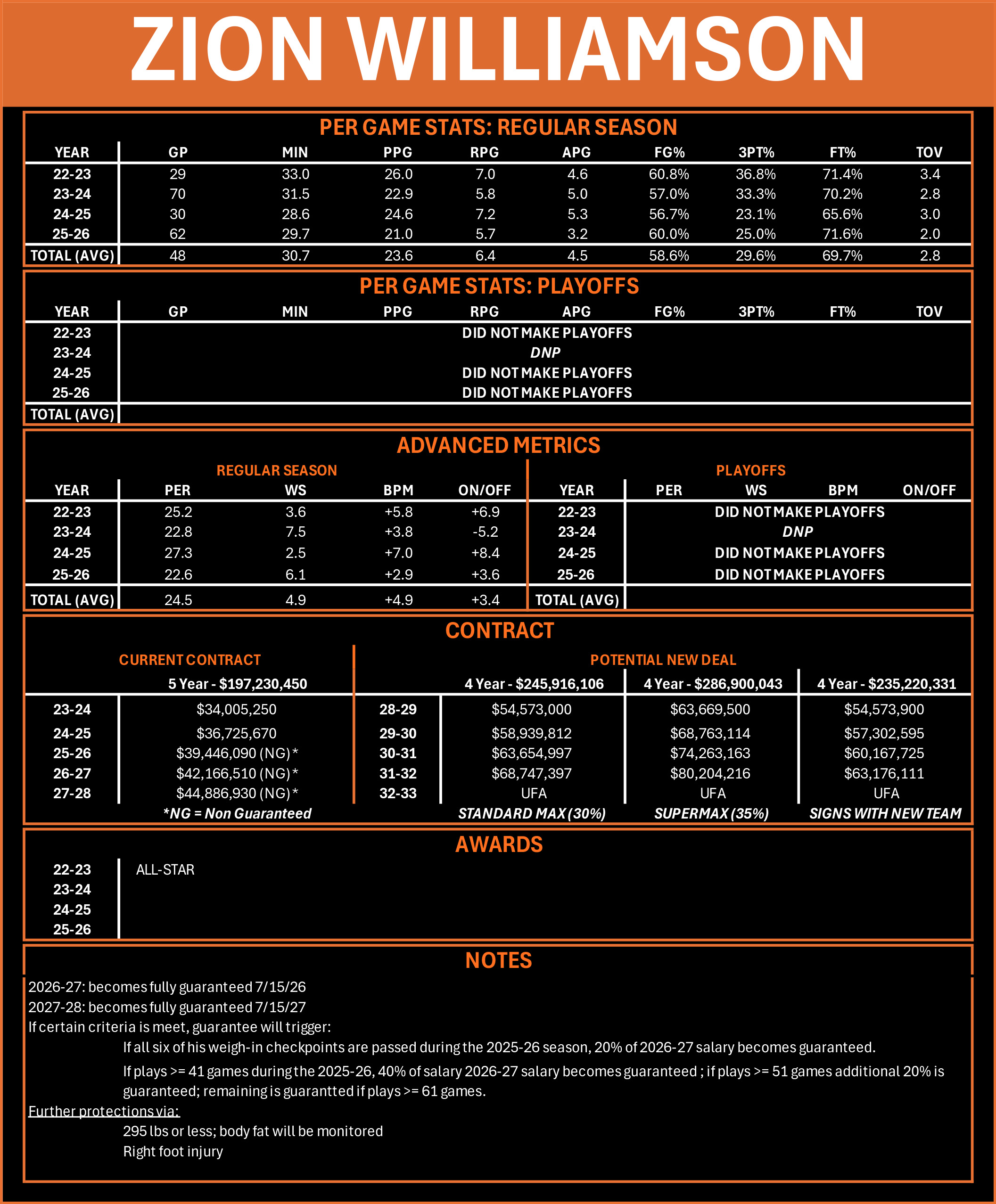
Over the last four years, he has averaged 48 games per season, just 59% of the regular season schedule. He has never played in a playoff game. His lone postseason moment was a 40‑point explosion in the Play‑In.
His contract is one of the most unique in the league. Multiple years are non‑guaranteed. Guarantees trigger if he hits weight checkpoints. Additional guarantees trigger based on games played. The Pelicans have protections tied to his right foot and weight. It is a contract built for risk management because the Pelicans knew exactly what they were signing up for.
The reality for Zion is that his ceiling still projects as elite with development and maturity, but the league now treats him like a high-risk asset, not a franchise pillar. Though the contract numbers shown below represent his maximum potential future contract, his realistic market will more than likely mirror his current contract.
As for the New Orleans Pelicans, Willie Green was fired. The coach who led them to the playoffs. Another reset. Another direction change. Another attempt to build something stable. There is promise, though. A new head coach in Jamahl Mosley and a young core that features Derek Queen, Jeremiah Fears Jr., Yves Missi, and a healthy Dejounte Murray. A young core with real upside. What they need now is cap space, assets, and a clean slate.
New Orleans Pelicans General Manager Joe Dumars has stated publicly that he has no intentions to trade Zion. For future success, trading Zion is the move. Not because he failed, but because the Pelicans can’t keep pretending this is going to turn around.
2. JA MORANT — MEMPHIS GRIZZLIES
Ja Morant wasn’t just a star. He was supposed to be one of the faces of the league. In 2021–22, he had the NBA in his hands with his explosive, electric, and unstoppable playstyle. A superstar who made Memphis relevant again.
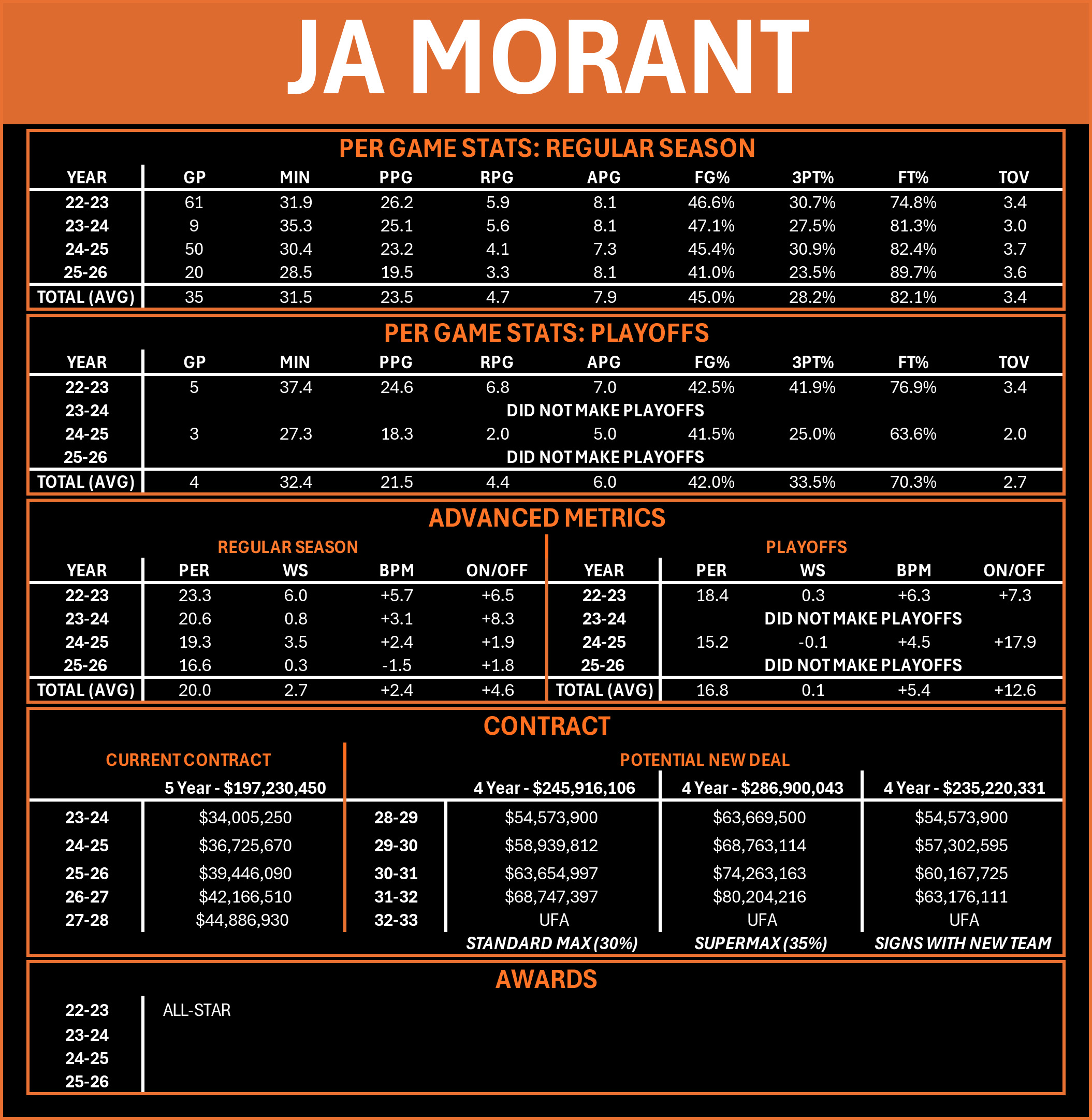
But the off‑court issues never stopped. The PR disasters piled up. The suspensions came. And the availability cratered. This season, he played twenty games. His injury history (shoulder, knee, hand, soft‑tissue issues) is now a crisis, and his style of play only increases the risk.
Teams don’t want the attention. Teams don’t want the volatility. Teams don’t want the uncertainty.
And Memphis? They need a reset. They already traded Jaren Jackson Jr. They hold the No. 3 pick. They can take a lead guard in Darius Acuff, Mikel Brown, Kingston Flemings, or Darryn Peterson, or pivot to a forward in Cam Boozer or Caleb Wilson to replace Jaren Jackson Jr.
A real trade concept exists: Ja Morant and the No. 3 pick to Chicago for Patrick Williams and pieces. Chicago has the $60 million in cap space to make it happen. Chicago could include No. 4 or keep it, based on the associated risks they would be bringing in. But here’s the irony: if Memphis was already a dangerous environment for Ja, I don’t believe Chicago is exactly a cleaner one.
The contract numbers below represent Ja’s max potential earnings. His actual market? Much closer to a Zion-style contract: triggers, protections, and a team-friendly structure that reflects the risks that are now associated with him. Although it is ironic that the No. 1 and No. 2 picks from the 2019 NBA Draft could be on such contracts, rather than supermaxes, and having their respective teams in the championship picture.
Ja can still be effective. But the Grizzlies may have to accept pennies on the dollar to move on and rebuild cleanly. Both sides need a reset.
1. GIANNIS ANTETOKOUNMPO — MILWAUKEE BUCKS
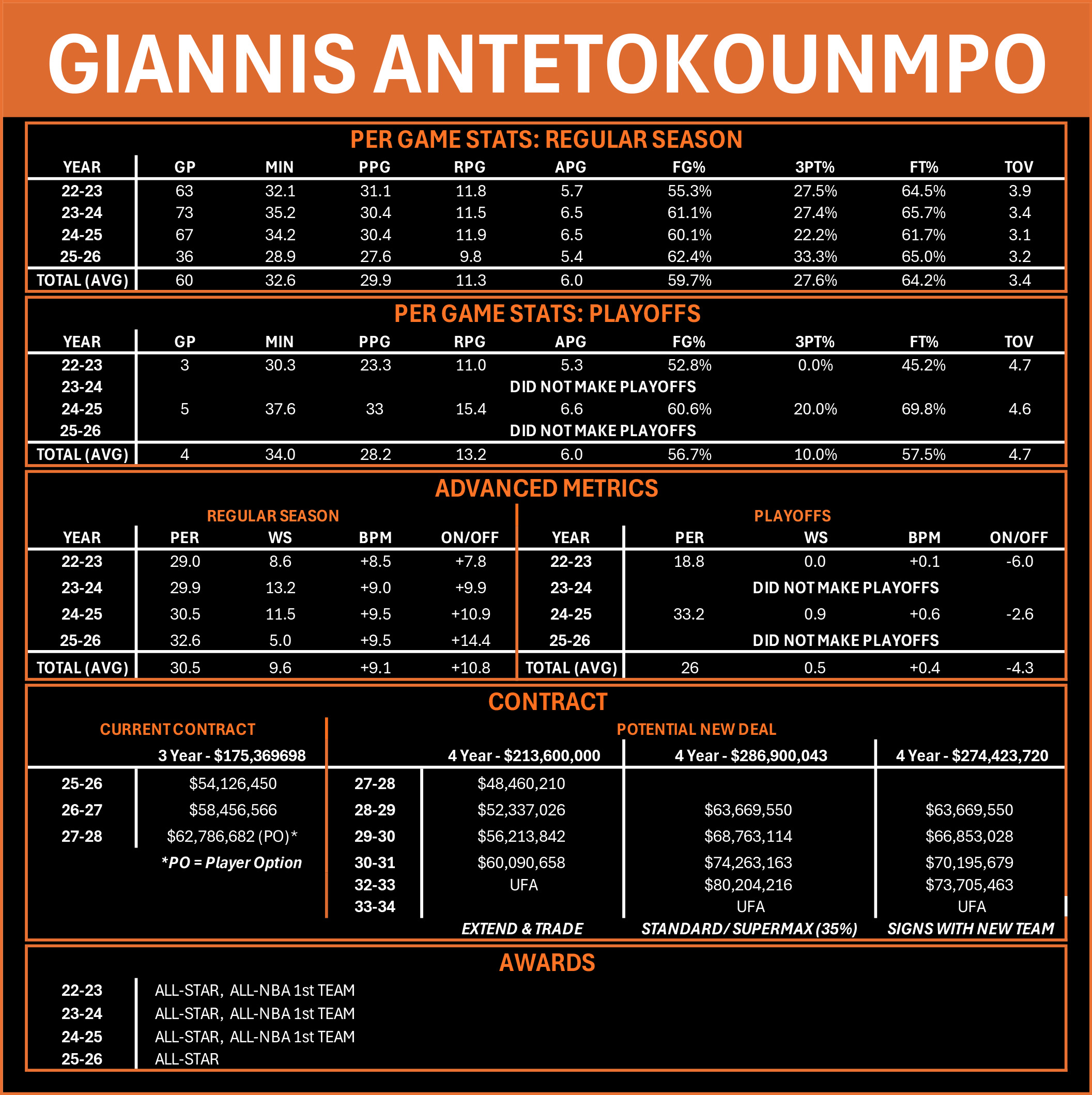
Giannis is still a top‑five player in the world, but the Bucks are no longer a top‑five franchise. The championship core is gone. Brook Lopez is gone. Khris Middleton is gone. Jrue Holiday is gone. And what’s left is a roster that’s too old, too expensive, and too inflexible to build a real contender around Giannis again.
The truth is uncomfortable: Giannis wants out. Not publicly. Not dramatically. But the signs are there. He’s 31 with nearly a decade of elite basketball left. His contract balloons into the mid‑$60 million range. And Milwaukee has no cap space, no young core, and no path to meaningful improvement.
And let me be honest: Giannis has prioritized keeping his brothers on the roster over maximizing competitiveness. It’s loyalty in true form, but it’s also a sign that the competitive window in Milwaukee is closed.
Giannis delivered a championship. He has nothing left to prove there. The Bucks, meanwhile, have everything to gain by moving him while his value is still at its absolute peak.
Giannis still has multiple elite years left, but Milwaukee no longer has the roster or cap flexibility to match that window. Any team that trades for Giannis will be paying for the final chapter of his prime.
The NBA is a league defined by timing. Stars rise and fall. Contracts age. Injuries reshape careers. And franchises must constantly decide whether the player they love is still the player they need.
This article isn’t about tearing down stars. It’s about evaluating player alignment, the same way real front offices do.
Because the hardest question in basketball isn’t “Is he good?” It’s “Is he still good for us?”
––––––––––––––––––––––––––––––––––––––––––––––––––––––––––––––––––––––––––––––––––––––––––––––––
APPENDIX A — NBA Contracts & CBA Rules
A quick, simple guide to how NBA money actually works.
Rookie Extensions (25% vs. 30%)
- 25% Rookie Max: Standard starting salary for players coming off rookie deals.
- 30% Rookie Supermax: Triggered if a young player makes All‑NBA, wins MVP, or wins DPOY before the extension begins.
Veteran Max Contracts (30% vs. 35%)
- 30% Max: For players with 7–9 years of experience.
- 35% Max: Automatic once a player hits 10+ years.
- Veteran Supermax: Allows a 7–9-year player to jump early to 35% with All‑NBA, MVP, or DPOY.
Why Staying Pays More
- Re‑signing with own team: Up to 5 years, 8% raises. (why stars extend, instead of leave.)
- Signing with a new team: Max 4 years, 5% raises.
Bird Rights (Why Extensions Are Even Possible)
- Teams allowed to go over the cap. Extensions require bird rights, not cap space
- This is what allows 5‑year deals and 8% raises.
The 140% Rule
- If a player already makes more than the standard max, a new extension can start at 140% of their previous salary.
- This prevents stars from taking a pay cut just because they’re already expensive.
- It’s also why “extend‑and‑trade” deals often cost players millions.
The Over‑38 Rule
- If a contract runs past a player’s 38th birthday, the NBA forces those future salaries to count immediately on the cap.
- Teams avoid this by giving older stars shorter deals (usually 2–3 years).
Trade Kickers (15% Bonus Clause)
- A trade kicker gives a player a bonus up to 15% of their remaining salary if traded.
- The old team pays the bonus; the new team must count it on their cap.
- A kicker can’t push a player above their legal max salary.
Contract Length
- Extensions: Up to 4 new years.
- Re‑signing with current team: Up to 5 years.
- Signing with a new team: Max 4 years.
APPENDIX B — Statistical Definitions
Basic Stats
- GP — Games played
- MP — Minutes per game
- PPG — Points per game
- RPG — Rebounds per game
- APG — Assists per game
- FG% — Field goal percentage
- 3PT% — Three‑point percentage
- FT% — Free‑throw percentage
- TOV – Turnovers per game
Advanced Metrics
- PER — Player Efficiency Rating (overall impact per minute)
- WS — Win Shares (how many wins a player contributes to)
- BPM — Box Plus/Minus (impact per 100 possessions)
- On/Off — Team net rating with player on vs. off the floor
––––––––––––––––––––––––––––––––––––––––––––––––––––––––––––––––––––––––––––––––––––––––––––––––
APPENDIX C — Salary Cap Projections
2026-2027 | $165,000,000 |
2027-2028 | $173,250,000 |
2028-2029 | $181,913,000 |
2029-2030 | $191,009,000 |
2030-2031 | $200,559,000 |
2031-2032 | $210,587,000 |
2032-2033 | $221,116,000 |
2033-2034 | $232,172,000 |
2034-2035 | $243,781,000 |
*These projections were used to calculate the salary breakdowns for each player. *